
I have been obsessed with homemade mead lately and so far I’ve made 3 different recipes ranging from very basic (only 3 ingredients!), to pretty complex. There’s so much room to explore but before I get into the how, I’d like to start with the what, the why and the how.
What is Mead?
Mead is the most ancient documented form of fermented beverage. It’s main ingredients are: honey, water, yeast and time. That’s it! The end product makes between a 5-12% alcohol and while we know how damaging alcohol overindulgence can be to a body, mead is actually quite beneficial. (For comparison, commercial Kombucha normally has about .5% alcohol but homebrewed kombucha has up to 3% alcohol or more depending on how long you like yours to ferment).
Why drink Mead?
In doing my research on mead I was blown away by the number of health benefits associated with mead. According to mead historian Robert Gayre “From the earliest times, men have recognized that honey, and particularly mead, have strong revitalizing qualities, as well as healing virtues.” ( quoted from Sacred and Herbal Healing Beers by Stephen Harrod Buhner, p. 35). Even our mythology respects mead as being a beverage both given by the gods, as well as being a beverage they drank themselves. Honey has long been found to possess antibiotic, antiviral, anti-inflammatory, expectorant, anti-allergenic, anti-fungal, and immune-stimulating properties. It’s important to note that all fermented beverages possess the medicinal actions of the ingredients they are made from. The fermentation process acts as a solvent, making different components more bioavailable and easy to absorb. Honey also acts as a solvent and contains the medicinal properties of the plants the bees pollinated when they made the honey. It’s also important to remember that fermented beverages contain probiotics and enzymes that help support and balance the gut flora. Want to try your hand at making some? It’s easy!
Basic Mead Recipe:
1 quart raw wildflower honey
3 quarts filtered water (no chlorine)
½ package of yeast (can be bread yeast but I prefer champagne yeast)
Glass fermentation vessel
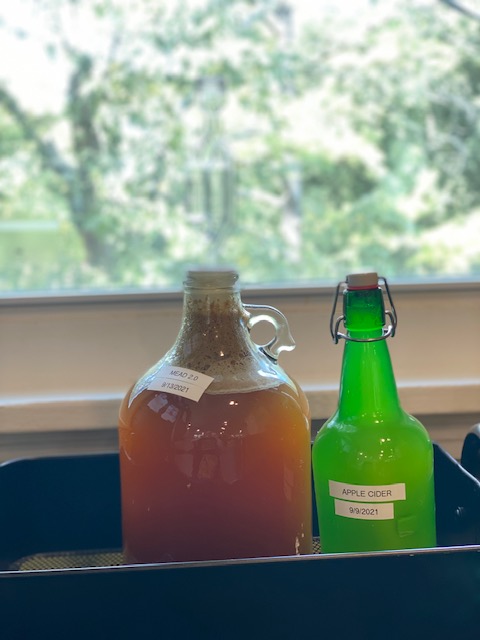
Warm the honey gently (do not warm it over 70 degrees) to make it easier to combine with the water. Do not use distilled water (the minerals are stripped from distilled water and the yeast needs trace minerals), do not use tap water unless you know it has not been chlorinated or fluoridated. Filtered water is best. Add the yeast, place in a fermentation vessel with an airlock or place in a vessel with a lid that you can burp daily. Do not fill all the way to the top as the yeast will produce a lot of bubbles in the first few days. I always put my fermentation vessels on a tray in a cool place away from direct sunlight. Fermentation can be messy if it “boils” out so make sure wherever you put it, it is protected. You can leave it 16-26 days before you bottle it for longer-term
storage but you can also drink it at that point if you don’t have the patience to age it. I’ll be sampling mine at 26 days.
This is a very basic recipe and if you are interested in making mead there are a ton of resources online to help. I just wanted to show you how simple it can be to start your first mead. Also, if you are local I will be teaching a class on probiotic sodas, meads and herbal beers. Tickets are available on eventbrite
 Thorn and Thistle Apothecary